








Best selling author and perennial thought provoker, posted something on LinkedIn recently that caught my eye:
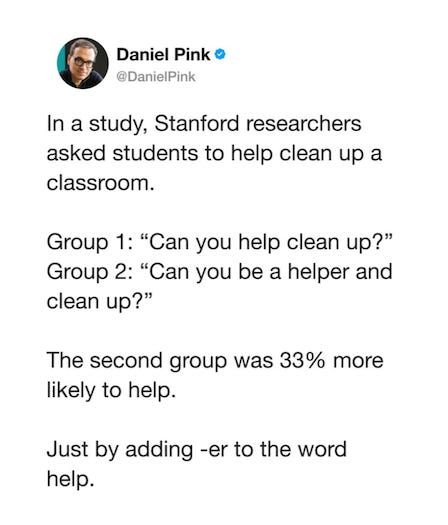
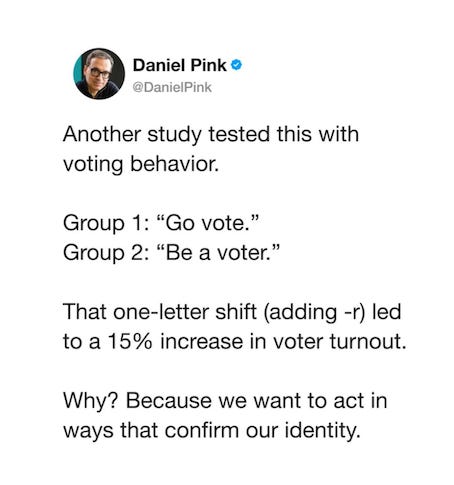
Pink concludes that using nouns instead of verbs as part of a request is motivating in that it allows the listener to see themselves as the actor in the situation, with a particular identity. Seeing themselves as the noun, the listener has ownership of the action, what would otherwise be the non-personalized verb.
This same notion of identity is why it’s effective to tell stories that connect with an individual’s Guiding Narrative.® The Guiding Narrative® subconsciously tells the individual how the world works and what their role and behavior in the world should be.
When you tell stories in which the individual recognizes themselves as a protagonist, as the role consistent with the one their Guiding Narrative® constantly reinforces, they feel seen, heard, and understood. Their identify is validated.
Hence, the difference, for example, between these two stories told to parents deciding whether to send their child to a new high school:
- Story 1: 83% of our graduates are accepted into Ivy League Schools.
- Story 2: We help our students discover their passions and shape their lives around them.
While these two stories are not mutually exclusive (in fact they could overlap), each speaks to a different, implicit core role a parent will recognize they play in the lives of their children. And while each might be appealing on some level to any parent, one story has the potential to reach certain parents at a deeper, more personal level, than the other.
Guiding Narratives® are the most personal and compelling part of a person’s identity you can identify, touch, and reinforce as a communicator. Whether you’re a business trying to work with a customer, a team member working with colleague, or a friend relating to another friend, consider the individual’s Guiding Narrative®, or one shared by a group, as the pathway to connection.
See and voice their noun.

