







In my last post I wrote about a gap — the one between what your customers are actually communicating and what our best interpretation of their behavior and words suggests they mean. Today I want to share a couple analogies that together may explain the gap most precisely. I will also introduce a solution that can close that gap.
The Rosetta Stone
In 1799, a stone was discovered in Egypt bearing the same text in three languages — one of which scholars could already read. It became the key that unlocked ancient Egyptian hieroglyphics, a written language that had been silent for nearly 1,400 years. It’s called the Rosetta Stone.
There’s something about the Rosetta Stone that’s easy to overlook.
It didn’t reveal new information. It unlocked information that had been sitting there for centuries — in plain sight, in museums, carved into walls — completely mute. One artifact, and suddenly an entire civilization had a coherent, accessible voice. The world could finally decipher the meaning of what had always been there.
Before the Rosetta Stone, scholars didn’t throw up their hands. They interpreted the hieroglyphic symbols. They brought experience and instinct to bear and produced answers that were reasoned, confident, and probably somewhat right. But there’s something disquieting about a civilization’s meaning being filtered through the imagination of so many scholars — however brilliant. The inscriptions were saying something specific. The interpretation was saying something plausible. Plausible, but in the form of a constructed story never verified by the only true source — the people themselves who created it. And there was no way to know how plausible — no context, no key, no ground truth to measure against.
Art, in the Wild
Let’s consider something more contemporary, a more familiar, and more relevant version of this same problem. Think, for example, of “Every Breath You Take” by The Police.
Every breath you take
And every move you make
Every bond you break
Every step you take
I’ll be watching you . . .
. . . Oh, can’t you see
You belong to me?
How my poor heart aches
With every step you take? . . .
. . . Since you’ve gone, I’ve been lost without a trace
I dream at night, I can only see your face
I look around, but it’s you I can’t replace
I feel so cold, and I long for your embrace
I keep crying, baby, baby please
Many people have heard this song as a passionate love song. It feels true. It lands emotionally. But Sting has been unambiguous: he wrote it about obsession and control. A surveillance anthem, not a romantic one. One’s hearing of it as a passionate love anthem isn’t wrong — but it isn’t accurate to the person who lived it and wrote it. And that distinction matters enormously. Placing a different frame on the song’s intent changes the meaning of each word.
If we were creating a message or a product for Sting on the heels of this song, a campaign about romantic love might miss entirely. A campaign about power and possession would land squarely.
This is what conventional market research does when it interprets observations, survey and interview responses, and even personal, natural conversations of the group being studied. It doesn’t leave you in the dark — it provides an interpretation. The problem is it’s an interpretation ultimately shaped by the mindframe and imagination capacity of those analyzing the data — their paradigm. This frame and capacity shapes the questions we ask, what we hear in the answers, and the meaning we finally assign. The customer’s experience and is filtered through someone else’s imagination the entire way through.
This is a recipe for quiet, persistent uncertainty.
The path to solving uncertainty
I’ve conducted every kind of human primary research on behalf of clients — surveys, focus groups, ethnographic interviews, discourse analysis. And these tools are valuable. I’ve seen them deliver real insight. But I’ve also seen what they can’t reach.
Behavior can be observed. Words can be collected. It all can be triangulated. But what people do and what people say are both like shadows on the wall. Neither gets you to the source as a context — to the meaning your customers are quietly making of their own lives, their own choices, their own relationship with your brand.
We naturally and reasonably confuse the shadow of a thing for the thing itself — until something gives us direct access to the source.
Enter the Guiding Narrative® method of gaining customer insight. Like the Rosetta Stone, it’s not another research tool to add to the pile. It’s the key that makes everything in the pile finally coherent — finally readable on its own terms. It recontextualizes your existing data, grounds your brand decisions in the lived experience of your customers and gives you something no survey or algorithm or AI can manufacture — a direct line to the story your customers are quietly telling themselves to make sense of their world. In other words, how they make meaning — of their lives, of your products, of your brand.
(The diagram below illustrates the cause and effect of adopting a traditional view of customer insight and one grounded in the Guiding Narrative® Method.)
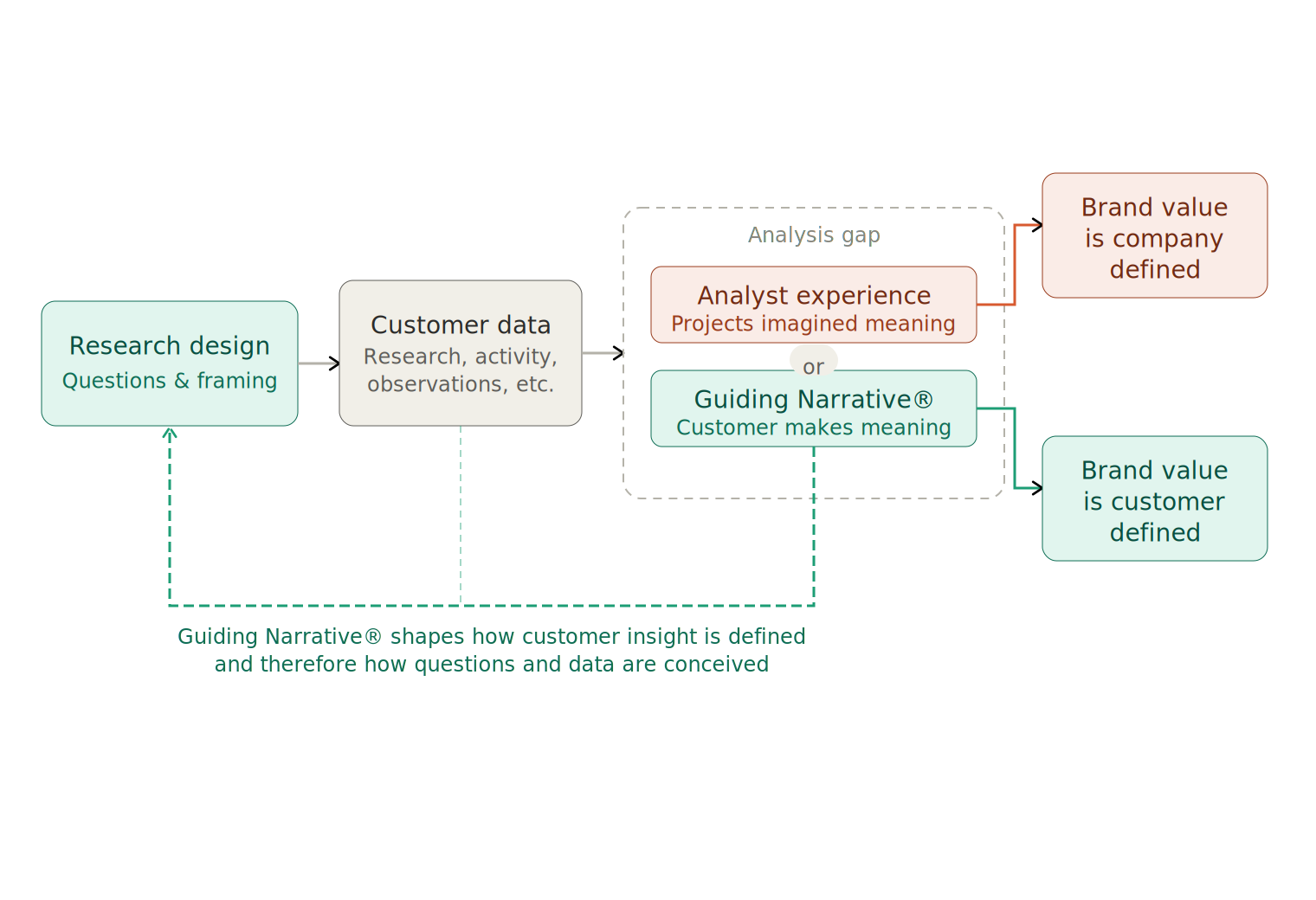
This distinction is critical because real confidence comes from clarity. And clarity comes from the source. You need a key to process the world, and data, the way the source does.
In my next post, I’ll walk through the Guiding Narrative® Method. What happens when you have that key in your hands — and what changes, permanently, for the leaders and organizations that use it.
If this resonates, feel free to share it with someone who’s been living with that quiet uncertainty of the analyst’s interpretation, whether that analyst is you, an in-house research team, an outside vendor or specialist, or combination of all three.
And if you want to talk about what clarity could look like for your brand, reach out directly by email or feel free to find a time on my calendar for a brief Zoom meeting.

