







The Earth does what?
In 1543, a strange thing happened: The sun, which had forever revolved around the earth, suddenly stopped, and the earth began revolving around the sun.
Crazy, huh?
Well, they called Nicolaus Copernicus crazy — the guy who suspected the earth was indeed moving around the sun, not the other way around.
In 1543, following Copernicus’ death, a German printer named Johannes Petreius published De revolutionibus orbium coelestium (On the Revolutions of the Heavenly Spheres). It contained Copernicus’ core theories. The document asserted what came to be known as the heliocentric model of the universe:
- The Earth and other planets orbit the Sun.
- Earth rotates on its axis daily.
It took nearly a century, but Galileo, later armed with a newly improved version of the telescope, pointed it toward the sky and gathered yet more evidence that supported the heliocentric model.
It can’t be true
The Catholic Church was not pleased with these developments. In 1616, it declared heliocentrism “heretical.” Galileo was investigated and eventually tried by the Roman Inquisition in 1633 and forced to recant his theories. He spent the rest of his life under what amounted to house arrest.
Some more time and a few more scientists (Kepler, Newton), and eventually we explained and accepted that the earth does indeed revolve around the sun. We still accept that widely. For now.
History is riddled with examples of what we know giving way to something that contradicts what we knew. Women in the U.S. will never own land, vote, or be able to sign for their own credit card. The heart is the center of thought and consciousness, not the brain. The New England Patriots will keep winning.
Why do we want to be certain?
It may be that we are only comfortable when we think we know the “truth” or know how to predict what will happen tomorrow. Seems reasonable.
And that’s good for certain things — like that the sun will come up, and we’ll have air to breath, and that the car traveling the opposite direction on a two-lane road will stay in its lane (not always certain). We still should hold a bit a healthy skepticism about these things.
But about most things in everyday life? Isn’t is better to wonder what might be beyond our certainty? Isn’t being constantly curious and skeptical more important to our survival than feeling like we can predict everything? Doesn’t “knowledge” inherently make us more limited, more vulnerable?
Consider this “Futility of Certainty” model below (Source: I made this up):
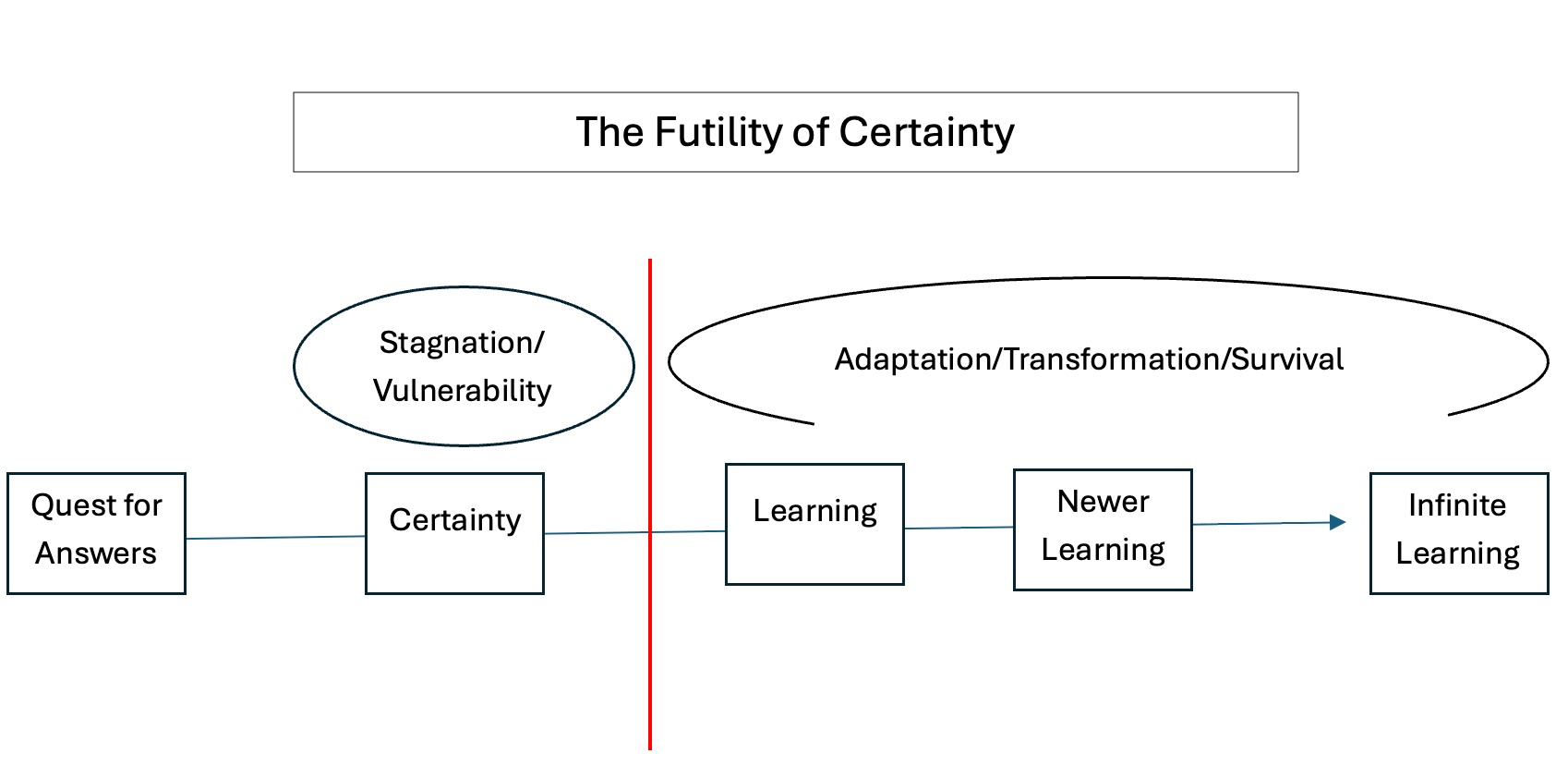
It seems to me that it’s infinitely smarter to be curious than certain. Hence the smartest person in the room is likely the one asking questions rather than supplying answers, for the most part.
So why do many of us prefer to be certain?
I’m not certain of the answer, but I’ll guess. We want stability and predictability, and that relies on a foundation of certainty.
How do we live with uncertainty?
How would we function if we’re left uncertain all the time? We need rules, and facts, and agreed upon understanding, don’t we?
That’s where grace comes in. We recognize that what we claim to “know” is the best we have at the moment, and we’re open to new ideas. Be suspicious of anyone who claims to have the answers, at the same time recognize that none of us does.
To be in a constant state of grace when it comes to knowledge is liberating.
You might think that our science and scientific tools were primitive prior to Copernicus, and that’s why we were confused about the relationship between the Sun and Earth, but that now we know. What do you think future generations will think of our “advanced” tools today? Oh, and will the earth always revolve around the Sun? Are you sure?
We seem to stop searching when we’re comfortable with the answer to our questions. There could be more, though. That’s curiosity.
If for you journey of discovery is not messy but rather neat and tidy, it’s likely that you want to feel certain more than you want to be know what more there is to know. It was easier for both Copernicus and Galileo to be certain rather than curious. Good thing for us they were curious.
So it seems, in the end, we don’t really have knowledge. We have narratives about knowledge.
Is your Guiding Narrative® built around certainty? Or around the futility of certainty? Or somewhere in between?

